On May 5th I drove up to Portland, Maine to attend the Association of Colleges and Research Libraries’ New England Conference where I co-presented a poster with my colleague, Jennifer Chaput.
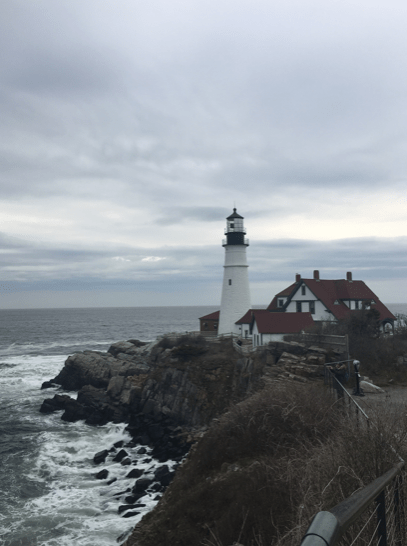
Above: a picture I took of Portland Head Lighthouse
I attended four different breakout sessions and came away with the most useful takeaways from two of the sessions. The first was called, “Pain-Free Deselection: Leveraging Community and Data.” During this session Lauren Slingluff of UConn (formerly at Wheaton College in MA) and Kate Henke from Wheaton College in MA, talked about their approach to deselecting books from the library where no weeding had been done previously, or at least it had been many decades. When a university has no offsite storage for books or money for offsite storage, deselection or removing books from the stacks is a reality. What data is used to make an informed decision? Lauren explained that Wheaton used Greenglass , a tool from OCLC to make informed decisions. Criteria used for weeding books included monographs that were:
- published more than 15 years ago
- had 0 recorded uses (never checked out)
- were held by more than 15 libraries in Massachusetts
- owned by at least 25 libraries in USA
- digitized by the Hathi Trust
- and held no intrinsic, historical, or financial value
These criteria are cloned to Greenglass and subsequently downloaded to an Excel spreadsheet. Faculty were also notified of the list of titles to be weeded one time per semester, and they had the option to opt out of these e-mails.
Of course, weeding books will be different depending on whether a library is at a small college or a large research institution. Wheaton College’s collections serve the needs of a small liberal arts college. The value of a book can be difficult to determine in my opinion, but it was useful to hear about how Wheaton approached this process to make informed decisions.
The next useful breakout session that I attended was titled, “On the Fringe: How Data Professionals Collaborate for Stronger Programs.” For this panel, Patty Condon of UNH, Thea Atwood of UMass Amherst, and Catherine DeRose of Yale spoke about their collaborations on campus beyond the library. Patty spoke about the importance of developing strategic partnerships with key stakeholders. Through her collaboration with the Research Computing Center at UNH, she wanted to provide science researchers with grants enough local storage for their data. Eventually, because not all researchers are funded with grants, she was able to provide 2 terabytes of free storage per researcher for active research data. Patty also highlighted the importance of looking for mutual benefit when establishing new relationships on campus. Thea Atwood spoke about her “I’m a PI, Now What?” workshop series. During conversation, Jen Ferguson from Northeastern talked about the importance of getting involved with the research grant process in terms of compliance pre and post award.
After lunch Jennifer and I presented our poster titled “Opening Doors for Research Success: Data Management Programming and Outreach.” The theme of this year’s conference was “opening doors” for others on campus, so we talked about how we help researchers on campus with our workshops, consultations, and programming. I have posted a copy of the poster on the Open Science Framework’s scholarly commons.
 Renée Walsh
Leave a comment