On May 14th I travelled to Miami for the RDAP (Research Data Access and Preservation) association’s annual summit. This year is the first year that RDAP was an independent organization. Formerly, RDAP was associated directly with ASIS&T, the Association for Information Science and Technology. Last year, RDAP voted to separate from ASIS&T in order to have greater control and autonomy over its organization and programming.
In this blog post I will first comment on some of my takeaways about research data management programming at universities in the US. During the first panel on repositories and curation, panelists from UC Santa Barbara talked about teaching students to “identify and isolate reusable datasets” which are accompanied by defined metadata and documented in a README.txt file. Janée talked about the following data management principles:
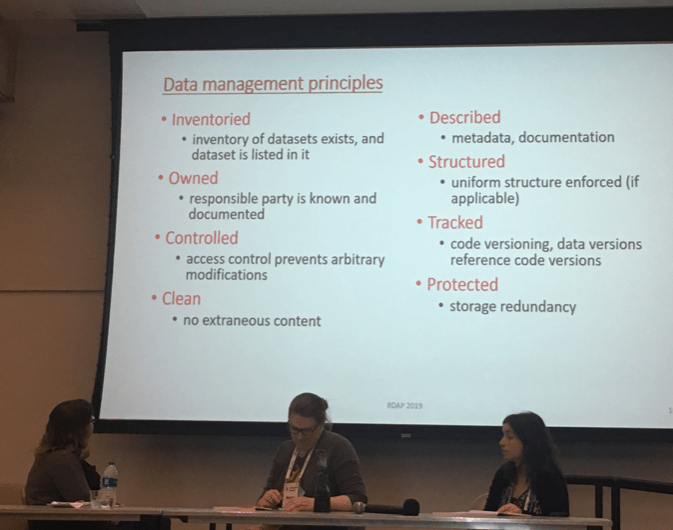
Data are
- Inventoried
- Owned
- Controlled
- Clean
- Described
- Structured
- Tracked
- Protected
The most common way of describing well managed data uses the FAIR acronym. Data are findable, accessible, interoperable, and reusable. Nevertheless, there is also the DATA acronym. Data are:
- Discoverable
- Accessible
- Transparent
- Actionable
Thu Mai Christian, assistant director of the Odum Institute talked about being mindful of the use of jargon when teaching research data management. For example, she says “support your data” instead of “research data management.” Instead of reproducibility, she says “show your work.” Data librarians from NC State also mentioned the importance of explaining RDM vocabulary and jargon by creating a glossary of terminology for workshop attendees NC State librarians mentioned the glossary created by Cornell University librarians, available here: Cornell RDM Glossary
Programming:
- Arizona State University recently offered a day-long event sponsored by the campus library called, “Practical Steps for Increasing Openness and Reproducibility.” This event was hosted by the Open Science Framework.
- UW Madison hosts a “Data Story Slam” as well as an event about so-called “Data Horror Stories.”
In other news:
- Code Ocean now supports Git versioning
- Figshare has a podcast called School of Batman. Find it here: School of Batman
In summary, I took a lot away from attending this year’s summit, and I look forward to next year’s in Santa Fe!
Poster:
Also, I presented a poster at the summit, which talked about how my colleague, Jennifer Chaput and I revitalized a dormant Research Data Management program on campus over our first two years at UConn. You can find that file on OSF here: Renee’s RDAP 2019 Poster
In other news:
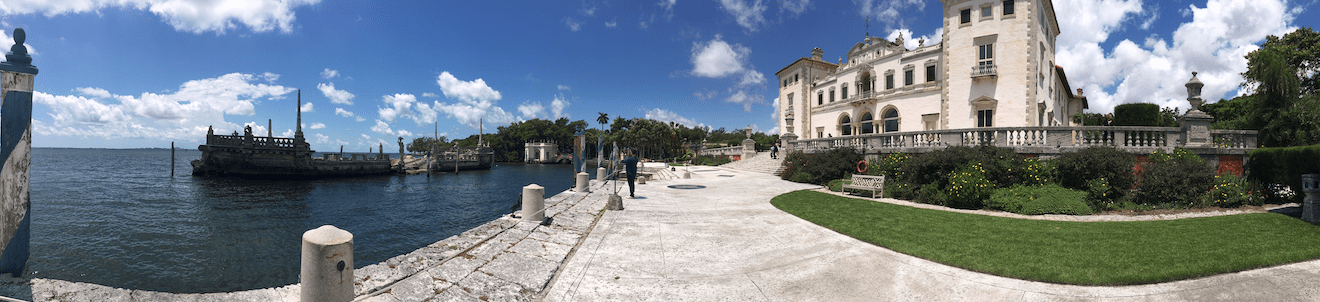
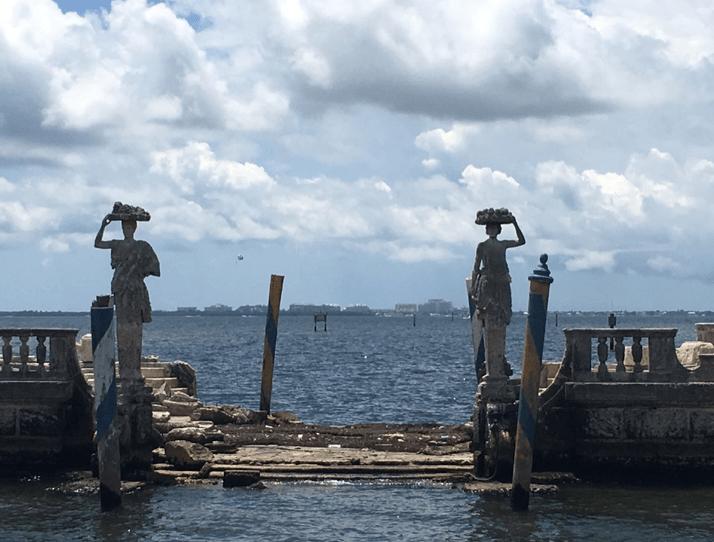
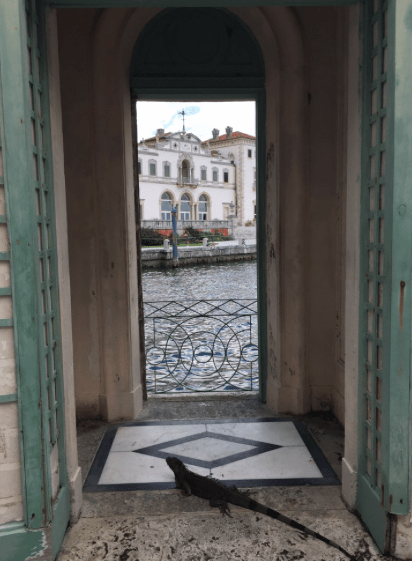
On Saturday, I had time to visit the Vizcaya Museum and Gardens, which are beautiful. It was built in the early 20th century by businessman James Deering. It is built like a mishmash of Italianate architecture, rococo, and gilded age splendor. The waterfront boat with statues lays partially in ruin, which only accentuates the beauty of the setting.
 Renée Walsh
Leave a comment